Fine-Tuning Datasets: Bad Data In, Bad Model Out (2026)
Last updated: March 2026
How to Build Fine-Tuning Datasets for LLMs: Format, Quality & Scale
Most fine-tuning failures are dataset failures. The training code is almost never the problem — SFTTrainer, Unsloth, and standard PEFT pipelines are well-tested and work reliably. The model and the training config matter, but within a reasonable range, quality differences from hyperparameter tuning are modest. Dataset quality, on the other hand, is the primary variable that separates fine-tuned models that work in production from ones that don't.
I've reviewed fine-tuning projects where engineers spent two weeks tuning learning rates and LoRA ranks while the training data contained formatting inconsistencies, duplicate examples, and outputs written at the wrong level of detail. Fixing the data took a day and produced a better model than all the hyperparameter experiments combined.
This guide covers the full dataset pipeline: format selection, sourcing, quality filtering, deduplication, and synthetic data generation. All code is practical and runnable.
Concept Overview
LLM fine-tuning datasets are instruction-response pairs. The fundamental question is: what does "good" look like for your task, and do your training examples faithfully represent that?
Three main data formats:
Alpaca format (single-turn, optional context):
{
  "instruction": "Translate this English text to French",
  "input": "The weather is beautiful today.",
  "output": "Le temps est magnifique aujourd'hui."
}
ShareGPT format (multi-turn conversations):
{
  "conversations": [
    {"from": "human", "value": "What is gradient descent?"},
    {"from": "gpt",   "value": "Gradient descent is an optimization algorithm..."},
    {"from": "human", "value": "How does the learning rate affect it?"},
    {"from": "gpt",   "value": "The learning rate controls step size..."}
  ]
}
OpenAI messages format (recommended for modern models):
{
  "messages": [
    {"role": "system", "content": "You are a data science tutor."},
    {"role": "user",   "content": "What is gradient descent?"},
    {"role": "assistant", "content": "Gradient descent is an optimization algorithm..."}
  ]
}
The OpenAI messages format is the standard in 2026. All major model families (Llama, Mistral, Phi, Gemma, Qwen) have official chat templates that expect this format. Use it unless you have a specific reason not to.
Data quantity guidelines by task:
| Task Type | Minimum | Target | Notes |
|---|---|---|---|
| Output format enforcement | 200–500 | 1,000 | Short, repetitive — easy to overfit |
| Style/tone adaptation | 500–1,000 | 2,000–5,000 | Needs diversity of topics |
| Domain-specific QA | 1,000–2,000 | 5,000–10,000 | Cover edge cases |
| Code generation | 2,000–5,000 | 10,000+ | Wide variety of problems |
| General instruction following | 10,000+ | 50,000+ | Broad coverage required |
How It Works
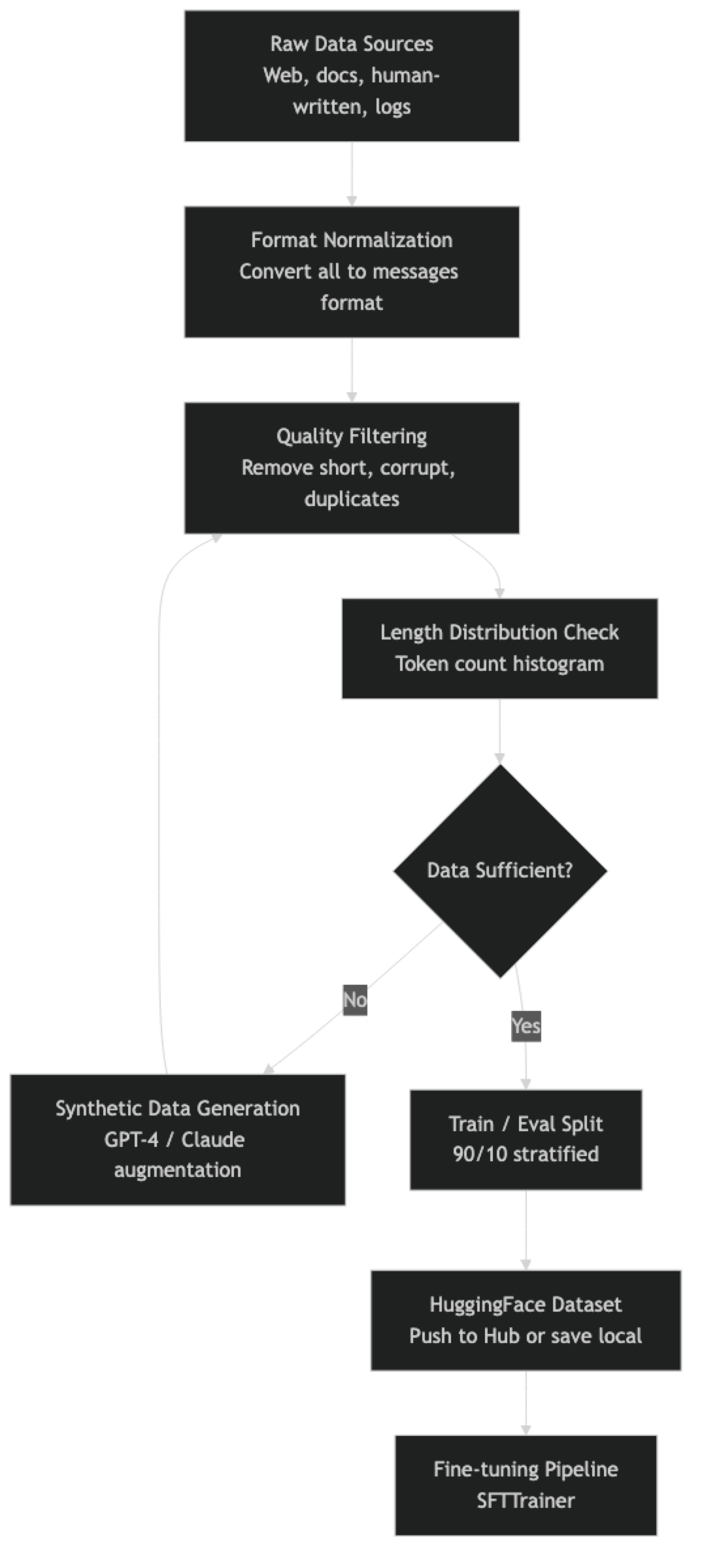
In practice, the filtering and synthetic generation steps are iterative. You filter, discover you have 400 examples after filtering (not enough), generate synthetic data, filter the synthetic data, and then combine.
Implementation Example
Step 1: Load and Normalize Data from Multiple Sources
import json
from datasets import Dataset, concatenate_datasets, load_dataset
from typing import Optional

def normalize_to_messages(example: dict, source_format: str) -> Optional[dict]:
    """Convert any format to the standard messages format."""

    if source_format == "alpaca":
        instruction = example.get("instruction", "").strip()
        context = example.get("input", "").strip()
        output = example.get("output", "").strip()

        if not instruction or not output:
            return None

        user_content = f"{instruction}\n\n{context}".strip() if context else instruction

        return {
            "messages": [
                {"role": "user",      "content": user_content},
                {"role": "assistant", "content": output}
            ]
        }

    elif source_format == "sharegpt":
        conversations = example.get("conversations", [])
        messages = []
        role_map = {"human": "user", "gpt": "assistant", "system": "system"}

        for turn in conversations:
            role = role_map.get(turn.get("from", ""), None)
            value = turn.get("value", "").strip()
            if role and value:
                messages.append({"role": role, "content": value})

        # Must have at least one user and one assistant turn
        roles = {m["role"] for m in messages}
        if "user" not in roles or "assistant" not in roles:
            return None

        return {"messages": messages}

    elif source_format == "messages":
        messages = example.get("messages", [])
        if len(messages) < 2:
            return None
        return {"messages": messages}

    return None

# Load from multiple sources and normalize
sources = [
    ("path/to/alpaca_data.jsonl", "alpaca"),
    ("path/to/sharegpt_data.jsonl", "sharegpt"),
]

all_examples = []
for filepath, fmt in sources:
    with open(filepath) as f:
        for line in f:
            example = json.loads(line)
            normalized = normalize_to_messages(example, fmt)
            if normalized:
                all_examples.append(normalized)

print(f"Total normalized examples: {len(all_examples)}")
raw_dataset = Dataset.from_list(all_examples)
Step 2: Quality Filtering
from transformers import AutoTokenizer
import re

tokenizer = AutoTokenizer.from_pretrained("meta-llama/Meta-Llama-3-8B-Instruct")

def compute_token_count(example):
    """Tokenize and count tokens for the full conversation."""
    text = tokenizer.apply_chat_template(
        example["messages"], tokenize=False, add_generation_prompt=False
    )
    tokens = tokenizer.encode(text)
    return {"token_count": len(tokens), "formatted_text": text}

def is_high_quality(example):
    """Filter out low-quality examples."""
    messages = example["messages"]

    # Get assistant responses
    assistant_turns = [m for m in messages if m["role"] == "assistant"]
    user_turns = [m for m in messages if m["role"] == "user"]

    if not assistant_turns or not user_turns:
        return False

    for turn in assistant_turns:
        content = turn["content"].strip()

        # Filter: too short (likely incomplete)
        if len(content) < 50:
            return False

        # Filter: too long (may be junk data)
        if len(content) > 4000:
            return False

        # Filter: repetitive content (sign of model collapse in synthetic data)
        words = content.split()
        if len(words) > 20:
            unique_word_ratio = len(set(words)) / len(words)
            if unique_word_ratio < 0.4:
                return False

        # Filter: known low-quality patterns
        bad_patterns = [
            r"As an AI language model,? I (can't|cannot|don't|am unable)",
            r"I'm sorry,? but I (can't|cannot|am not able to)",
            r"^Sure!? Here (is|are)",  # Sycophantic openers
        ]
        for pattern in bad_patterns:
            if re.search(pattern, content, re.IGNORECASE):
                return False

    # Filter: token count bounds
    if example.get("token_count", 0) < 50 or example.get("token_count", 0) > 2048:
        return False

    return True

# Apply quality filters
print("Computing token counts...")
dataset = raw_dataset.map(compute_token_count, desc="Tokenizing")

print("Filtering...")
before = len(dataset)
dataset = dataset.filter(is_high_quality, desc="Quality filtering")
after = len(dataset)
print(f"After filtering: {after}/{before} examples retained ({100*after/before:.1f}%)")
Step 3: Deduplication
import hashlib

def compute_hash(example):
    """Hash first user message for near-duplicate detection."""
    first_user = next(
        (m["content"] for m in example["messages"] if m["role"] == "user"), ""
    )
    # Normalize: lowercase, remove extra whitespace
    normalized = " ".join(first_user.lower().split())
    hash_val = hashlib.md5(normalized.encode()).hexdigest()
    return {"content_hash": hash_val}

dataset = dataset.map(compute_hash)

# Remove exact duplicates based on hash
seen_hashes = set()
def is_not_duplicate(example):
    h = example["content_hash"]
    if h in seen_hashes:
        return False
    seen_hashes.add(h)
    return True

before = len(dataset)
dataset = dataset.filter(is_not_duplicate)
after = len(dataset)
print(f"After deduplication: {after}/{before} ({(before-after)} duplicates removed)")
Step 4: Synthetic Data Generation with GPT-4
from openai import OpenAI

client = OpenAI()

DOMAIN = "Python backend development"
SEED_TOPICS = [
    "async/await patterns",
    "database connection pooling",
    "FastAPI dependency injection",
    "Redis caching strategies",
    "Docker containerization",
    "error handling best practices",
    "JWT authentication",
    "rate limiting",
]

def generate_instruction_pair(topic: str) -> Optional[dict]:
    """Generate a high-quality instruction-response pair for a topic."""

    meta_prompt = f"""You are creating training data for a {DOMAIN} AI assistant.

Generate ONE detailed, realistic technical question about {topic} that a senior developer might ask.
Then write an expert answer that is specific, technically accurate, and immediately useful.

Format your response as JSON:
{{
    "instruction": "the technical question here",
    "output": "the detailed expert answer here"
}}

Requirements:
- The question must be specific and practical, not vague
- The answer must be at least 150 words
- Include code examples where appropriate
- Do not start the answer with "Sure!" or "Of course!"
- Do not mention that you are an AI"""

    try:
        response = client.chat.completions.create(
            model="gpt-4o",
            messages=[{"role": "user", "content": meta_prompt}],
            temperature=0.8,
            response_format={"type": "json_object"},
        )

        data = json.loads(response.choices[0].message.content)

        if len(data.get("instruction", "")) < 20:
            return None
        if len(data.get("output", "")) < 100:
            return None

        return {
            "messages": [
                {"role": "system", "content": f"You are an expert {DOMAIN} engineer."},
                {"role": "user",   "content": data["instruction"]},
                {"role": "assistant", "content": data["output"]},
            ]
        }

    except Exception as e:
        print(f"Generation error for topic '{topic}': {e}")
        return None

# Generate 1,000 synthetic examples
synthetic_examples = []
target = 1000
examples_per_topic = target // len(SEED_TOPICS)

for topic in SEED_TOPICS:
    topic_examples = 0
    attempts = 0
    print(f"Generating for topic: {topic}")

    while topic_examples < examples_per_topic and attempts < examples_per_topic * 3:
        example = generate_instruction_pair(topic)
        attempts += 1
        if example:
            synthetic_examples.append(example)
            topic_examples += 1

    print(f"  Generated {topic_examples}/{examples_per_topic}")

print(f"\nTotal synthetic examples generated: {len(synthetic_examples)}")
synthetic_dataset = Dataset.from_list(synthetic_examples)
Step 5: Combine, Split, and Save
# Combine real and synthetic data
final_dataset = concatenate_datasets([dataset, synthetic_dataset])
print(f"Final dataset size: {len(final_dataset)}")

# Stratified split
split = final_dataset.train_test_split(test_size=0.1, seed=42)
train_ds = split["train"]
eval_ds  = split["test"]

print(f"Train: {len(train_ds)}, Eval: {len(eval_ds)}")

# Add formatted text column for SFTTrainer
def add_formatted_text(example):
    text = tokenizer.apply_chat_template(
        example["messages"], tokenize=False, add_generation_prompt=False
    )
    return {"text": text}

train_ds = train_ds.map(add_formatted_text)
eval_ds  = eval_ds.map(add_formatted_text)

# Save locally
train_ds.to_json("./data/train.jsonl")
eval_ds.to_json("./data/eval.jsonl")

# Optionally push to HuggingFace Hub
# train_ds.push_to_hub("your-username/your-dataset-name", split="train")

print("Dataset saved.")

# Print token count statistics
import numpy as np
token_counts = [len(tokenizer.encode(ex["text"])) for ex in train_ds]
print(f"\nToken count statistics:")
print(f"  Min: {min(token_counts)}")
print(f"  Max: {max(token_counts)}")
print(f"  Mean: {np.mean(token_counts):.0f}")
print(f"  Median: {np.median(token_counts):.0f}")
print(f"  95th percentile: {np.percentile(token_counts, 95):.0f}")
Best Practices
Quality over quantity, measurably. Before finalizing your dataset, manually review 50 random examples. If you find problems in more than 10% of them, your filtering is insufficient. It is faster to invest time in filtering than to discover quality issues after a training run.
Set max_seq_length based on the 95th percentile of your token count distribution. If 95% of examples are under 1,024 tokens, setting max_seq_length=2048 wastes memory and slows training. Truncation at the 95th percentile loses very little data while improving training efficiency.
Log your data pipeline decisions. Record how many examples were removed at each filtering step. When you update the dataset, you need to know whether a quality change came from new data, different filtering, or training config changes.
Validate distribution balance. If 80% of your examples cover one topic, the model will be disproportionately good at that topic. Check distribution with simple category labeling before training.
Common Mistakes
Not verifying that outputs don't leak the instruction format. If your training output accidentally contains the user's question restated before the actual answer, the model will learn this behavior. Check the formatted text, not just the raw JSON.
Generating synthetic data with the same temperature across all topics. Complex technical topics benefit from lower temperature (0.5–0.7) for accuracy. Creative or diverse topics benefit from higher temperature (0.8–1.0). Using a flat temperature often produces bland data for creative tasks and hallucinated data for technical ones.
Including outputs that exceed
max_seq_lengthwithout truncation warning. SFTTrainer silently truncates examples that exceedmax_seq_length. If your responses are long and getting truncated, the model trains on incomplete outputs — which can produce cut-off responses at inference time.Mixing system prompts and no-system-prompt examples without awareness. If some training examples have system prompts and others don't, the model will behave differently with and without a system prompt at inference. Decide on a convention and apply it consistently.
Using low-quality public datasets without review. Many popular instruction datasets (early Alpaca variants, some ShareGPT datasets) contain factual errors, inconsistent style, and poor-quality responses. Always review a sample before including any public dataset.
Key Takeaways
- Dataset quality is the highest-leverage variable in fine-tuning: 500 well-filtered, diverse examples consistently outperform 10,000 scraped examples with noisy labels.
- The OpenAI messages format with role-labeled turns is the standard in 2026 and compatible with all major model families — use it and apply it through
tokenizer.apply_chat_template(). - Always normalize data from multiple sources to a single format before mixing; mismatched formats produce a model that has learned conflicting behavioral patterns.
- Aggressively filter for quality: remove examples with responses under 50 characters, known sycophantic openers, high word repetition ratios, and token counts outside your training window.
- Deduplicate based on normalized first user message hashes — duplicate prompts with the same response teach the model to memorize, not generalize.
- Set
max_seq_lengthbased on the 95th percentile of your token count distribution; training on a window much larger than your data wastes VRAM and slows training. - Synthetic data generation with GPT-4o costs roughly $5–15 per 1,000 examples and can supplement real data when volume is insufficient — but apply the same quality filters to synthetic outputs.
- Train on a 200–300 example subset first before running a full training job; if the model produces reasonable outputs from that small sample, the format and quality are correct.
FAQ
Should I use a public dataset or collect my own data? Start with your own data for domain-specific tasks — it will always be more relevant. Public datasets (Dolly, OpenHermes, Capybara) are useful for augmenting general instruction-following capability but may dilute domain-specific performance. The best approach is usually a base of real examples augmented with synthetic data.
How do I handle imbalanced datasets? If some categories have many more examples than others, either oversample the underrepresented categories or cap the overrepresented ones. Weighted sampling during training (via a custom data sampler) is also an option but adds complexity. Simple truncation of dominant categories is often sufficient.
How much does it cost to generate 1,000 synthetic examples with GPT-4? Using GPT-4o at roughly 500 input tokens and 300 output tokens per example: 1,000 x 800 tokens divided by 1M x $5 = $4 for output, plus $2.50 for input. Budget roughly $5–15 for 1,000 examples with GPT-4o, depending on prompt length and response length.
What is the best way to check if my data is high quality? Train on a small subset (200–300 examples) first and generate test outputs. If the model already produces reasonable outputs from 200 examples, the data format and quality are correct. If the outputs are clearly wrong or incoherent with 200 examples, the data has quality issues that more data will not fix.
What token count distribution is normal for a fine-tuning dataset?
For instruction-following tasks, most examples fall in the 100–800 token range. If your median is above 1,200 tokens, consider whether your responses are unnecessarily long. If your 95th percentile is under 512 tokens, you can set max_seq_length=512 and improve training efficiency significantly.
How do I detect and remove near-duplicate examples? Hash the normalized first user message (lowercase, whitespace stripped) using MD5. Track seen hashes in a set and skip any example whose hash has already appeared. This removes exact and near-exact prompt duplicates. For semantic deduplication at scale, use embedding-based clustering with cosine similarity thresholds around 0.95.
Should training examples always have a system prompt? Consistency matters more than the specific choice. If you include system prompts in some examples but not others, the model learns to behave differently depending on whether a system prompt is present at inference time. Pick one convention and apply it to every training example.